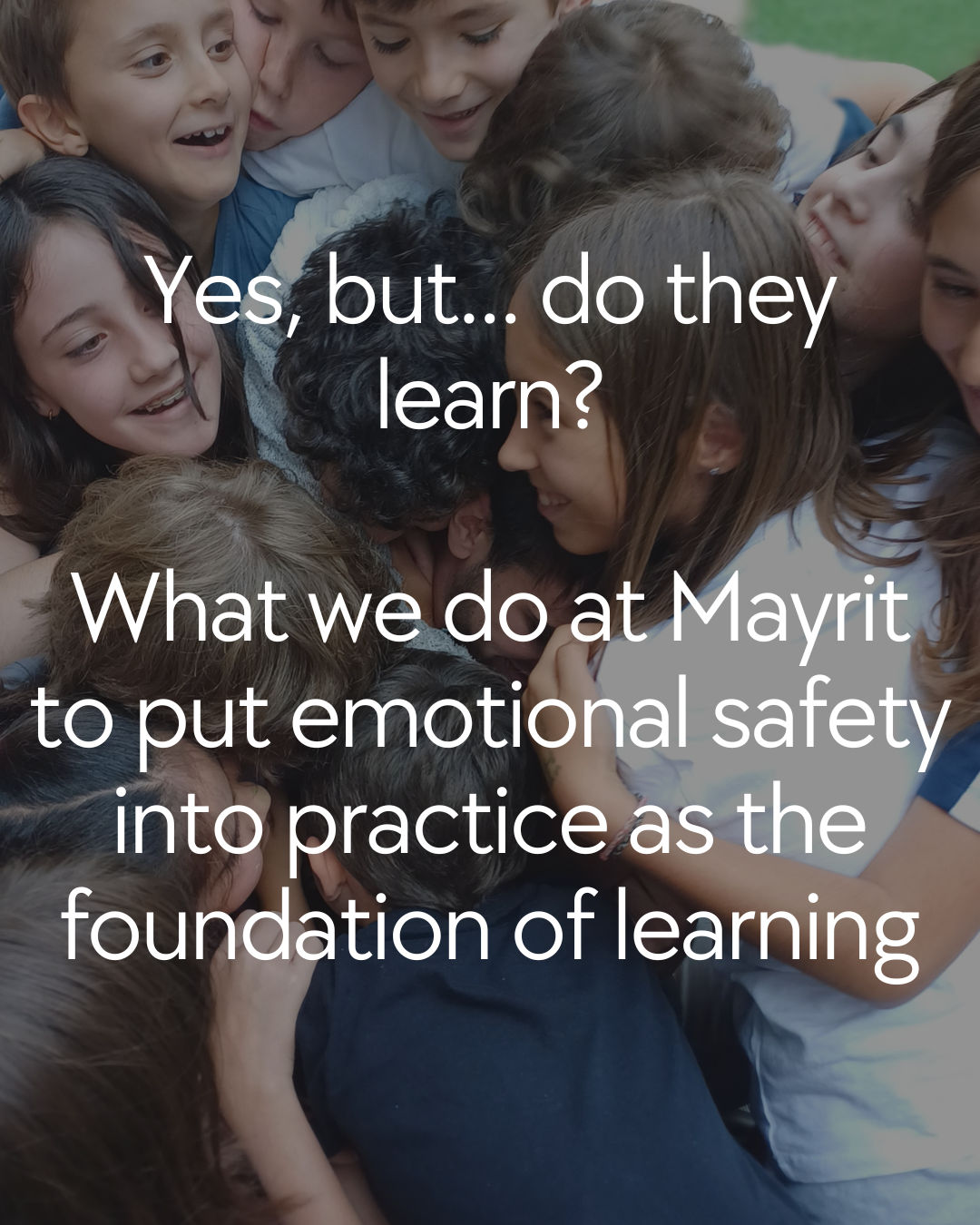
We continue our series “Yes, but… do they learn?” to address one of the most misunderstood pillars of active education: emotional accompaniment. It is often assumed that focusing on how students feel takes away from academic rigor. Current neuroeducation proves exactly the opposite.
No one learns deeply, meaningfully, and permanently when they feel insecure, disconnected, or under constant judgment. Emotional safety is not an “extra” or something separate from learning; it is its indispensable foundation.
When a child’s brain perceives a threat—such as the fear of ridicule or disproportionate punishment—it activates survival mode, freezing the prefrontal areas responsible for higher cognitive functions. Conversely, when a child feels emotionally safe, their innate curiosity unfolds: they can explore, ask questions, get frustrated, make mistakes, and try again without experiencing failure as a constant threat to who they are.
At Mayrit, as a Nursery and Primary school, this scientific premise is implemented daily across our school culture through very clear actions:
- True welcoming times: Mornings begin with a space for transition and a human welcome, rather than a rushed and mechanical entrance into the classroom. The day starts by recognizing how everyone is arriving.
- Conflict management through repair: When a relational difficulty arises, our priority is to understand what happened and guide the repair of the bond, rather than reacting automatically solely from a place of punishment or sanction.
- Respect for emotional overwhelm: If a student is overwhelmed or emotionally shut down, we do not expect them to immediately return to their academic task “as if nothing happened.” We support the distress before reconnecting with the demand.
- Firm yet protective boundaries: We uphold the boundaries necessary for coexistence firmly, completely eliminating any form of humiliation, threats, or ridicule.
What real life skills are consolidated in this environment?
The adult as an ally: Children learn to see the educator as a safe figure to turn to, not as a punitive element to hide from.
Resilience toward mistakes: The ability to make errors without freezing or punishing themselves internally.
Emotional literacy: The skill to identify, express, and progressively regulate what they feel.
Autonomous problem-solving: Tools to mediate and solve conflicts constructively.
To learn how to think critically and freely, one must first learn from a place of safety, not from a constant fear of making mistakes.
How do you approach the balance between emotional support and daily structure in your educational projects? We look forward to reading your thoughts in the comments.